800VDC: Why AI Data Centers Are Moving To High-Voltage DC Power
 Artificial intelligence is changing more than what happens inside a data center. It is changing the infrastructure required to power one.
As AI systems become larger and more computationally demanding, the amount of power required by individual server racks is increasing dramatically. NVIDIA, for example, is developing next-generation rack-scale systems designed around power requirements reaching 1 megawatt and beyond.
That kind of power density creates a fundamental infrastructure challenge: How do you efficiently move that much electricity through a data center and deliver it to the computing equipment that needs it?
One answer gaining significant industry attention is 800-volt direct current, or 800VDC.
For data center owners, operators and infrastructure decision-makers, it’s important to understand why this change is happening, what it could mean for future facilities, and what will be required to turn new power architectures into working infrastructure.
About the Author
 Justin Pratt is Alamon’s Supervisor of Electrical and Energy Services, bringing hands-on electrical experience and a strong background in critical infrastructure, renewable energy and power systems. A licensed Master Electrician in multiple states, Justin’s training includes grounding and bonding, transformers, motor controls, arc-flash safety and electrical installation practices. He helps lead Alamon’s work across electrical, energy and emerging infrastructure applications.
Why AI Is Changing Data Center Power
For decades, increases in computing power could generally be accommodated within familiar data center electrical architectures.
AI is accelerating the equation.
The processors used to train and operate large AI models require enormous amounts of computing capacity. Packing more of that capacity into each rack also concentrates the electrical demand.
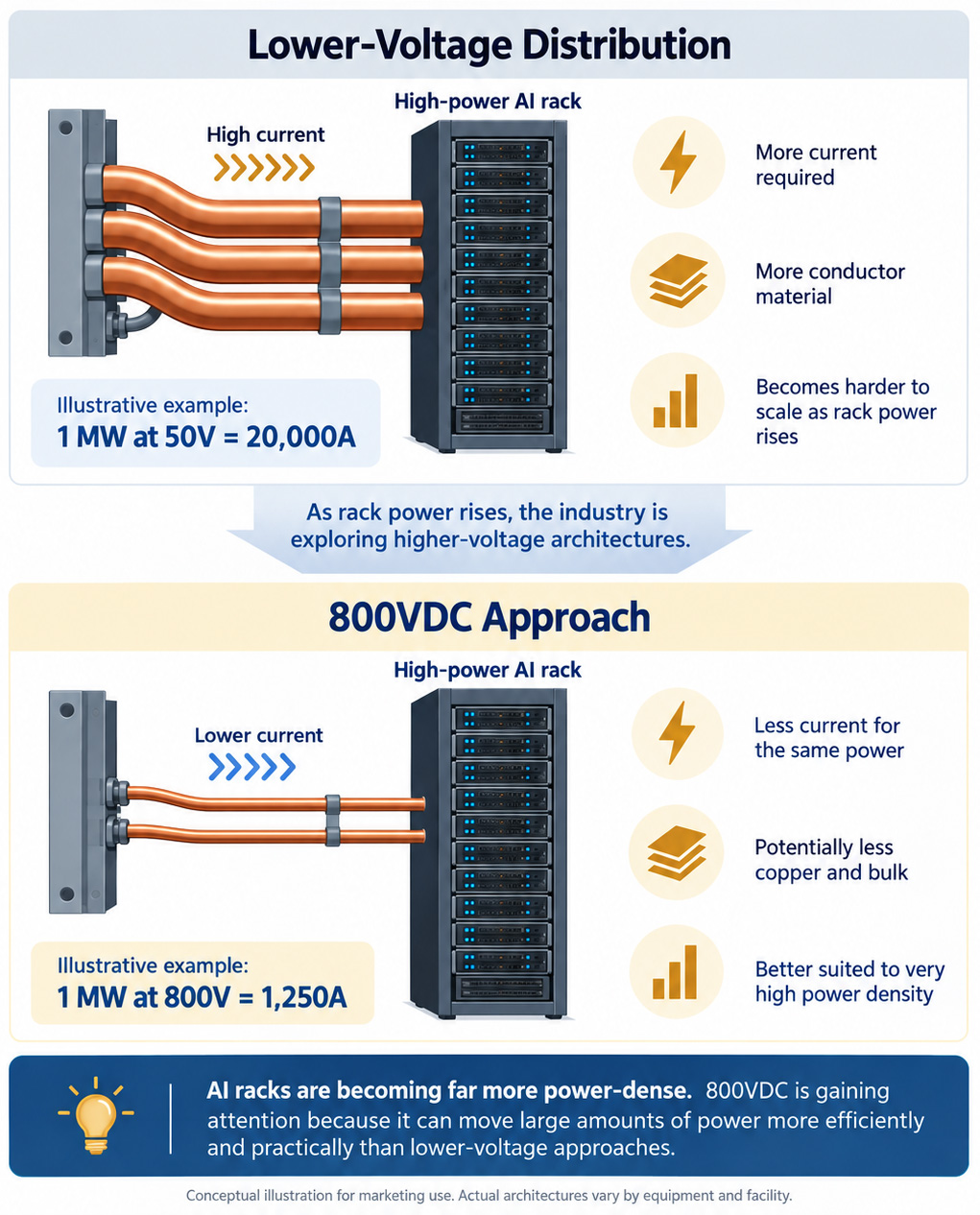
Today’s systems commonly distribute power within the rack at much lower DC voltages. That works well at conventional power densities. But as rack requirements climb into hundreds of kilowatts and eventually toward megawatt levels, moving that much power at relatively low voltage becomes increasingly difficult.
The reason comes down to basic physics.
For a given amount of power, increasing voltage reduces the amount of current that has to flow through the conductors carrying it. Lower current can reduce the amount of conductor material required and make it more practical to deliver extremely large amounts of power.
It is the same broad principle that has driven higher-voltage architectures in other industries facing increasing power demands.
For next-generation AI data centers, 800VDC offers a way to move substantially more power through the facility without simply making today’s lower-voltage systems larger and larger.
What Is 800VDC, and Why Is It Happening Now?
800VDC simply means electrical power distributed at approximately 800 volts of direct current.
The concept itself isn’t particularly complicated.
Rather than repeatedly converting and distributing electricity at lower voltages as power moves closer to the computing equipment, emerging 800VDC architectures are designed to move higher-voltage DC power farther through the data center before converting it to the much lower voltages ultimately required by processors.
That can create several potential advantages.
Higher-voltage distribution can reduce the current required to deliver a given amount of power. It can reduce the amount of copper and physical space required for power distribution. And new architectures may also reduce some of the conversion steps between the incoming electrical supply and the computing equipment.
For an industry confronting unprecedented power density, those advantages are significant.
 The idea of distributing higher-voltage DC power is not entirely new. What has changed is the scale of the problem.
AI infrastructure is pushing computing density — and therefore power density — to levels that previous data center architectures were not originally designed to support.
NVIDIA has outlined an 800VDC architecture intended to support IT racks reaching 1 megawatt and beyond beginning in 2027. At the same time, companies throughout the data center power ecosystem are developing the equipment and components required to support higher-voltage DC distribution.
That includes power conversion equipment, busways, rack-level conversion technologies, energy-storage systems and other supporting infrastructure.
In other words, 800VDC is moving from an industry discussion toward an emerging infrastructure ecosystem.
That doesn’t mean every data center is suddenly going to become an 800VDC facility.
Transitions of this scale happen over time. Existing architectures will continue to serve many facilities and workloads, while newer approaches are introduced where higher power densities justify them.
But the direction is important for companies planning the next generation of AI infrastructure.
The computing equipment is changing. The electrical infrastructure supporting it will have to change with it.
From Power Architecture to Physical Infrastructure
Much of the conversation around 800VDC understandably focuses on technology.
New processors. New power architectures. New conversion equipment. New distribution systems.
But every architecture eventually encounters the same practical reality: It has to be built.
Equipment has to be delivered and installed. Power systems have to be integrated. Distribution has to be constructed. Batteries and energy-storage systems have to be connected. Grounding has to be installed. Systems have to be tested, documented and placed into service.
And as higher-voltage DC architectures move from product roadmaps into operating data centers, the people performing that work will have to develop the appropriate skills, procedures and training for the equipment they are installing.